Home Blog Page 65

Delivery Man (2014)

0
"Hello everyone, my name is Vince Vaughn and I am clearly not dressed for this occasion."
“Hello everyone, my name is Vince Vaughn and I am clearly not dressed for this occasion.”

Twitter Plot Summary: David Wozniak finds out that, following his sperm bank donations, he is the father of 533 children. And his girlfriend is pregnant.

Five Point Summary:

1. Meat driver.
2. Money troubles, drugs, and a girlfriend who’s a police officer…
3. Weekend away with the kids. All 533 of them.
4. The court case resolves.
5. Ooh it’s a baby!

David Wozniak (Vaughn) is a man living a life with no direction. He delivers meat for the family business, is generally non-committal to his girlfriend, and he also happens to owe a ridiculous amount of money to some shady drug dealer types. All in all, his outlook is bleak. Then things get a whole lot worse – he finds out that he’s the target of a lawsuit from his 500-plus biological children. Yes, that does read correctly – 500-plus. Some years previously, David had made a ridiculous amount of donations at a sperm bank to earn some easy money, for reasons that will become apparent later. Rather than back off and let the matter fade into obscurity, David decides to meet some of his kids and act as a sort of guardian angel for them, like a non Quantum Leaping Sam Beckett.

Delivery Man is interesting in that it’s a remake of the recent French-Canadian production, but from the same writer/director of that film. Why it necessitated a remake, and so recently after the original too, with added Vince Vaughn, screams “blatant money making cash-in”, but then who am I to judge if that really is the case – it does at least get the film out to a wider audience. Case in point – I’d not heard of the original film until seeing this, and I’ll probably watch it at some point, so I’d say that counts as a win for the director.

Vaughn is in unnusually restrained form as David, although at times he does allow his typical sarcastic delivery come to the fore. Chris Pratt is in top form as David’s mostly inept lawyer, his inability to deal with four kids and their refusal to listen to a word he says no doubt a chilling reflection on the lives of many parents in the audience. Sadly for Cobie Smulders there is little for her to do except complain about David and his man-child existence and look attractive in a police uniform. Character development? Nada.

All he could do was ride away as fast as he could, and put the image of Cobie Smulders in a police uniform out of his mind.

The most engaging aspect for me was David meeting one of his kids who is disabled. This was actually quite a touching part of the story and grounds it in such a way that you can forgive some of the suspect plotting that occasionally creeps in. Vaughn does well to portray the emotional numbness that this meeting creates, and those scenes are worth the price of entry alone. Other than this, to say it’s an inoffensive Vince Vaughn vehicle would be entirely accurate. It’s nowhere near as bad as most of his recent output, but neither is it entirely spectacular. He gets to do something a little bit different and that’s be mostly normal. That in itself is not enough to sell the film for most, but it does at least have a pleasing core storyline that has a moderate emotional range to it, even if the entire situation is completely ridiculous in the first place. I’ve not seen the original French-Canadian film, and after this I’m not sure I need to. The story plays out with few or no surprises, and those expecting a typical Vince Vaughn comedy will be sorely disappointed. Still, the emotional heart of the film is solid, and may warrant at least a repeat viewing at some future, undisclosed date. Until then, file under “okay, but seen better”.

Score: 3/5

Once Upon A Time In America (1984)

0
All they could see was reel after reel after reel of movie film stock.

Twitter Plot Summary: The lives of four gangsters are played out over the course of fifty years.

Five Point Summary:

1. Will someone answer that telephone?!
2. Bugsy Don’t mess with him.
3. Worst identity parade ever.
4. Rape!
5. A secret doorway! How cunning!

Once Upon A Time In America is Sergio Leone’s magnum opus. 13+ years in the making Leone constructed a gangster film that arguably surpasses The Godfather in terms of impact and quality. I say arguably because I maintain that The Godfather is also a 5/5 movie, but there will always be people who prefer one of them over the other and as a massive fan of Leone’s previous work it’s this movie that wins the race. It’s a reasonably narrow margin, but Leone pips it by a whisker.

It is an incredibly long film, there’s no two ways about it. Yet despite the long running time it remains compelling from start to finish, for want of a better term it’s a masterpiece of narrative. Following the exploits of a small group of wannabe criminal masterminds across a period of 50 years, from their youth to their twilight years and all of their exploits in between, including butting heads with a young thug called Bugsy and the expansion of their bootlegging empire.

The heart of the story is the rivalry/brotherhood/whatever it is between De Niro’s Noodles and Woods’ Max. Max sends them deeper and deeper with the mafia whilst Noodles has severe misgivings about the whole venture. The narrative is driven by Noodles and his betrayal of Max – this is no spoiler as this is made clear within the first five minutes of the movie, as some clever cutting switches between the “present” and a comprehensive flashback to Noodles ratting out his friends, all of which is set to the constant ringing of a telephone.

That’s not to say that Noodles is entirely likeable – he graphically rapes a girl in the back of a car after she rejects his advances. He may have a certain code that he lives by, but being respectful towards women isn’t one of them. You could argue that he’s a product of his era, but that’s a flimsy argument at best. Max meanwhile, despite being ruthlessly ambitious, is an altogether more rounded personality and acts as a perfect counterpoint to Noodles – indeed, even from their very first meeting they are rivals, it just varies in severity as the years go by. The remaining members of the gang don’t get much room to expand their characters, this is very much about Max and Noodles.

Worst. Identity Parade. Ever.

can only level one complaint at this epic piece of epicness, and that’s the fact it could easily have been another hour longer and it would have still been compelling and a must-see. Leone really had a knack for telling a good story, and the mostly non-linear narrative works wonders here. Visual motifs and repeated shots – admittedly separated by years in terms of the narrative – help build the sense of location and the almost inevitable nature of their lives. Other little quirks such as the telephone ringing in the opening few minutes leave you wondering where the phone is ringing, who can hear it, is it a memory, a flashback, or both? So many questions from just a single scene.

Visually it has everything you would expect from a Leone movie – stunning locations, a very specific eye for detail in the period set flashbacks, and an eye for a simple camera shot/setup that still manages to cram a ridiculous amount of detail and meaning into every frame. This is a filmmaker at the peak of his powers, and it’s augmented by Ennio Morricone’s absorbing soundtrack. Equally at the top of his game, Morricone’s soundtrack is beauty incarnate. I can’t define in words how much I love his music, and when it’s a Leone/Morricone combo the only result is a win.

There are few movies of this quality out there, and whilst the gangster aspect may not appeal to everybody it’s still an amazing piece of cinema and should rightfully be positioned as one of the all time classics.

Score: 5/5

http://www.youtube.com/watch?v=mzhX2PD6Srw

Twelve O’Clock High (1949)

0
Judging from the smell, they both knew it was the co-pilot who'd let one fly.
Judging from the smell, they both knew it was the co-pilot who’d let one fly.

Twitter Plot Summary: World War 2, and an American bombing group are put back in shape by a stern General.

Five Point Summary:

1. A Toby mug
2. This unit lacks discipline. The bar’s closed!
3. Daylight precision bombing. Whose daft idea was that?
4. The General’s getting a little too hands-on.
5. He’s on the flight with them…

Some years after the war, a man spots a Toby mug in a shop window and buys it immediately. Flashing back to the Second World War, it becomes apparent that the same Toby mug was his unit’s mascot and symbolic of when a raid was called for. The group in question, the 918th, were involved in near-suicidal daylight precision bombing runs – there’s a good reason for the majority of bombing taking place at night, you know. You might survive a couple of bombing runs, for a starter. Twelve O’Clock High marks that rare occasion where a war film focusing on Americans isn’t a massive flag waving exercise, instead choosing to demonstrate that the constant need to head up into the skies and fight in the Second World War had a lasting psychological impact on those involved in the fighting, and specifically bomber crews who suffered some of the highest fatality rates in any theatre of the war.

Gregory Peck is General Frank Savage, the man given the task of bringing the bomb group back into shape, taking over from the previous commander who, whilst well liked and supported by his men, is starting to show the signs of burnout. Savage removes all of the privileges available to the crews in a bid to snap them into shape. Understandably all of the pilots put in for transfer to another group, and it’s then up to Savage to change their minds before the transfers can go through. It wouldn’t be much of a film if the transfers had succeeded, and it’s then a case of Savage trying to win them over to his way of thinking. As time passes and the group become more and more successful in their raids – all thanks to the hard work of General Savage, no less – we come full circle and he falls into the same trap as the previous commander. This is all told superbly through Peck’s performance, strict at first but slowly softening his approach as the group get result after result.

Peck always went "Method" in his roles. Here, he was playing both the plane and the pilot.
Peck always went “Method” in his roles. Here, he was playing both the plane and the pilot.

Being positioned so close to the end of the war and being shot in black and white, Twelve O’Clock High benefits from using real archive footage of air battles to add to the air of authenticity. This is enhanced by the airfield location and the solid performances from the remaining cast. They all invest themselves thoroughly in their characters and you can almost believe that you’re watching documentary footage rather than a film. Almost. Dean Jagger is in excellent form as Major Stovall, a man who had turned to drink; Hugh Marlowe is equally superb as Lt Col Gately who, in the face of cowardice and the possibility of upsetting his high-ranking father, is given command of the Leper Colony and the wash-outs within the group.

As one of the first films to showcase the psychological effects of wartime combat on pilots, Twelve O’Clock High is a triumph. It works as a war film certainly, but the focus on the lives of the pilots on the base rather than their exploits in battle is one to be commended.

Score: 4/5

Steamboat Bill Jr (1928)

0
This might not end well...
This might not end well…

Twitter Plot Summary: The son of a stereotypical riverboat captain returns home to join his father’s crew. And then a hurricane hits.

Five Point Summary:

1. Everybody’s wearing a white carnation! Guffaw!
2. A minor case of cat throwing.
3. That’s no place to stick a barber’s brush!
4. Singing in a silent film. But of course.
5. If he’d been stood in the wrong place…

With nothing but the sound of a piano as accompaniment, many silent films lived or died on the basis of the lead character’s performance. There aren’t a huge number of performers from this era that are instantly recognisable to many, but those who are on that short list are there because they are timeless entertainers. The likes of Laurel and Hardy, Charlie Chaplin and Greta Garbo are known for exactly that reason, and on that list is the star of this film – Buster Keaton.

The story sees Keaton’s slightly effeminate son of a riverboat captain return to join his father’s crew. Naturally his effete nature is at odds with the rough and tumble of the sailor’s life, and he’s soon butting heads with his father. Soon, Keaton’s William Canfield Jr meets Kitty King, daughter of a powerful local banker, and they start dating, much to the chagrin of their respective fathers. Notice – no mother figures present. That could explain a lot… After William Jr’s father is imprisoned by King, he tries to orchestrate his father’s escape but instead ends up in hospital. Then, a hurricane hits the town and it’s up to William Jr to rescue Kitty, his father and his prospective father in law. There’s no attempt to explain William Jr’s past, nor is it necessary. His mere presence and relationship with his father is plain enough to see. From this starting point we’re treated to an extensive repertoire of jokes and sight gags.

Keaton is excellent as Bill Jr, demonstrating a hefty amount of physical comedy without overplaying it. No, the likes of Laurel and Hardy and later the Marx Brothers were on hand to provide that type of over the top humour, but whilst there is a certain element of slapstick to Keaton’s performance, it’s altogether more grounded than by some of the material of his peers.

Bit of a stiff breeze, there.

It’s also astoundingly well directed given that it stems from the earliest Hollywood era, and Keaton was clearly a master of the art form even at such an early stage of its development. The stunts, performed live in camera, are an amazing technical achievement even by today’s standards. It’s even possible that today’s CGI-jaded audiences won’t recognise just how dangerous it was to drop the front of a building on top of Keaton – the stunt was performed for real and, had Keaton been stood in the wrong spot, he would have been crushed. That apparently wouldn’t have bothered him so much as he was going through a slightly depressed phase at the time of the film’s production, not that you can really tell from his performance.

Suffice to say I’m a big fan of this era of cinema, although as is often the case I haven’t seen nearly enough of it as I would like. It’s also evidence that it doesn’t matter what age the film or the subject matter – if it’s funny then you’ll laugh anyway. With Steamboat Bill Jr, you will laugh. A lot. High praise indeed.

Score: 4/5

https://www.youtube.com/watch?v=vjl2Fj-_Hg0

The Wolf of Wall Street (2014)

0
This is not standard office practice. Trust me.

Twitter Plot Summary: The rise and fall of Jordan Belfort, stockbroker, as he indulges in excess at the expense of his clients.

Five Point Summary:

1. Talking directly to the camera, eh? This could prove interesting.
2. Jonah Hill’s white teeth.
3. The empire builds…
4. The point where it probably should have finished.
5. Does anybody learn anything?

It seems that difficulties in the financial sector are cyclical. Every few years the inherent greed of those involved in that area results in a crash of epic proportions where everybody loses. The Wolf of Wall Street picks up in the 1980s where young, not-yet-corrupted stockbroker Jordan Belfort is taken under the wing of Matthew McConaughey’s slimey Mark Hanna, who teaches the young impressionable man that it’s not about making money for the client – it’s all about making money for yourself. The outcome for the client is immaterial, essentially. Hanna teaches Belfort that to succeed in stockbroking he needs to drink, take drugs and pleasure himself on a regular basis.

As the years pass and Belfort’s power and finances extends outwards and upwards, he comes under the scrutiny of the FBI and it is this aspect of his story that dominates the narrative as it moves inexorably onwards. It’s a big film, no two ways about it, both in concept and running time. I hear that Scorsese has a four hour cut somewhere, which I’d quite like to see despite my feeling that it could do with losing half an hour. Throughout the years Belfort gets through two wives, a copious amount of drugs and more women than you can shake a stick at. Unsurprisingly, DiCaprio looks like he’s having a ball inhabiting this persona.

The narrative style is an interesting choice, with DiCaprio narrating his tale and talking directly to the camera on occasion, almost as if he’s proud of what he’s done and wants everybody to know about it. This probably isn’t too far away from the truth in reality bearing in mind the type of person that Belfort is. He’s entirely unlikeable, but that’s not to say that we don’t end up routing for him to an extent. That’s supported by the comedy elements of the film, which are played so darkly comic that on occasion you’re not sure if you’re supposed to laugh. One definite laugh-out loud scene (without feeling bad about it) features DiCaprio and Hill high on old quaaludes (drugs) and perhaps some of the best physical comedy/acting that both have ever done.

Yep, that's what the film's all about.
Yep, that’s what the film’s all about.

A film of this length would be a chore if it wasn’t for the performances, and both DiCaprio and Jonah Hill are excellent as the central pairing. Rob Reiner has a good few minutes of screen time as Belfort’s father, and is as entertaining and amusing as you might hope. McConaughey’s not around for long, but his words set our story in motion and if you want to apportion blame to a specific character for how all of this ends up happening, it’s all his. That’s not to say that Belfort is blameless as he womanises, takes hard drugs and lives the high life, but he was set along that path and that lifestyle by others already engrossed in it, so subsequently you can’t blame him entirely for his actions. There’s also a strong major role debut from Margot Robbie, who brings several layers to what could easily have been a one note personality. With that said she doesn’t break any new ground as far as female roles in cinema are concerned, but she makes more of it than was on paper.

Some arguments have been levelled at Scorsese for apparently bigging up the decadence and, apparently, not making it clear whether he’s saying the decadence and stealing of millions of dollars of money was a good thing, or if he’s actually deriding it and poking fun at the existence of this type of behaviour. I know mine is just one voice amongst many when it comes to discussing this film, but to me it was quite clear that it’s the latter – this kind of behaviour is clearly not acceptable and Scorsese all but says as much. Just take a look at the scene whereby, amongst the excess taking place, a female employee has her head shaved just to get her hands on $10,000. This is most certainly not a celebration.

Is it far too long? Yes, most definitely. But then if you think about how the film is a commentary on excess, power and corruption, then the running time is just another example of that. By the end we’re right back where we started – wealth intoxicates and that, like people, will never change.

Score: 4.5/5

Jurassic Park (1993)

0
The Raptors knew somebody had been eating their Rice Krispies.

Twitter Plot Summary: John Hammond has built a theme park and filled it with cloned dinosaurs. This can only end badly, right?

Five Point Summary:

1. Sam Neill scares a kid. Hah.
2. A first glimpse of the future. Dinosaur special effects = epicness.
3. The T-Rex gives chase whilst Goldblum does his thing.
4. “Clever girl…”
5. Slightly deus ex machina ending, but we’ll let it slide.

Here’s a little story for you, just for a change. Jurassic Park was one of the few films I went to see at the cinema in the days before I had a disposable income. At a mere 9 years of age I went to our local cinema, the ABC on Unicorn Hill in Redditch (now a Lloyds bar and nightclub) to see the film along with my brother and my grandparents. I took a photo on the day, of my brother and grandparents stood in the queue (and it was a sizeable queue – it was a three screen cinema and the ticket booth was just inside the door). Because I was 9 and not very good at pointing a camera, I managed to cut off my grandparents’ heads, but despite this I have fond memories of that trip. Why? Because I spent most of the film running out to the toilet because I was scared of all the dinosaurs. I would like to say it was because the effects are incredibly realistic, but the stark reality is that I was scared of everything. Fast forward twenty years and to mark the anniversary of the film’s release it had a special IMAX run. Could the older, wiser me make it through the film without running screaming for the exit? Given the amount of times I’ve seen it in the intervening years without another such incident occurring, I had high hopes for success.

So, the story is that mega rich John Hammond has found a way to clone dinosaurs and has built a massive park on Isla Nublar. But before he can open it to the public he needs to have the park signed off by an array of experts in the field. Seeing as dinosaurs have been extinct for 65 million years, he has to rely on archaeologists Dr Grant and Dr Sattler, and chaos ensues when one of Hammond’s employees takes the power out and makes off with some dinosaur embryos to sell to a rival company. It’s then a question of survival as the dinosaurs take over the park and the remaining people left on the island try to get away at the earliest opportunity.

The real star of the film was not impressed when he discovered his pay was a tenth the size of Jeff Goldblum's.
The real star of the film was not impressed when he discovered his pay was a tenth the size of Jeff Goldblum’s.

The film itself is a riot, and with some deus ex machina aside, is a gripping story from start to finish. There are all of Spileberg’s staple elements present – characters we care about, a human story at the heart of the spectacle (in particular the development of Dr Grant’s attitude towards children), and most importantly of all – spectacular action set pieces. The story itself lacks depth, with corporate espionage and human frailty the reason for everything going horribly wrong, but much like the more recent Gravity, the story doesn’t have to be multi-layered if the rest of the film’s elements make up for it, and Jurassic Park delivers big on that front. We also get Jeff Goldblum doing his thing, which is a delight as always. Even the secondary characters have enjoyable moments, in particular Bob Peck as Muldoon, the park gamekeeper, whose dialogue I still quote on a regular basis (“Clever girl…” and so on). The effects were a revelation at the time, and whilst they may not look as impressive now what with twenty years worth of CGI development, they still have the power to generate amazement, if not the outright awe that we experienced in 1993.

I’ll return to this as and when I get round to reviewing The Lost World, but it’s clear that Jurassic Park would have been a completely different film, at least tonally, had Spielberg made Schindler’s List first (they were both released in 1993). It would have no doubt been a much darker, less family-friendly affair and maybe that’s why the second in the series wasn’t as warmly met as this opening entry. It’s worth noting that, having read Michael Crichton’s novel many years ago, the film interpretation is a much lighter affair. Yes there’s still the peril and the element of danger, but it’s not as dark as it could have been. Small mercies, perhaps.

Was the IMAX or the 3D worthwhile? No, not really, but seeing it on a massive screen was worth the price of entry. Needless to say, this time round I sat through the entire IMAX presentation and didn’t run out to the toilet at any point. I think the cowardly 9 year old me would be proud and/or inspired to stop being a cowardly sort. That unfortunately would have to wait until I went to university, another 9 whole years later and that, my friends, is a story for another time.

Score: 4.5/5

Birdemic: Shock and Terror (2010)

0
Yeah um... are we supposed to be scared of this?
Yeah um… are we supposed to be scared of this?

Twitter Plot Summary: Birds attack a small town and a couple try to survive the badly animated carnage.

Five Point Summary:

1. So many minutes of pointless driving…
2. That guy selling solar panels – does it add anything to the story?
3. Bad CGI! Bad attacks by birds!
4. Some lunatic in the woods with a bad toupee. 
5. So many minutes of staring out to sea…

Bad films can be a guilty pleasure under the right circumstances, and if you’re attuned to the fact it’s a bad film then it can be as equally enjoyable as one of the big blockbusters. That’s not to say the film’s any good, of course, because whilst it might be enjoyable on a certain level it’s frequently an example of how not to make a film. Step up, Birdemic: Shock and Terror, your time in the spotlight is nigh.

The story sees newly formed couple Rod and Nathalie retreating to a hotel room to consummate their relationship (despite as many have pointed out, that they have perfectly good homes of their own to do so). The morning after the world has fallen apart, as badly animated birds of all sizes and descriptions swoop down on the town and cause havoc. Some even explode on impact, kamikaze style. Who knew birds had such talents? Throughout their escape from the hot zone they encounter some orphaned children and a mad army veteran-type in the woods who blames it all on the corporations and global warming.

There are a number of basics you would expect from any film – decent camera work, clear audio/dialogue, a competent script and even half-decent special effects on occasion. Birdemic fails on every point. Audio levels are a mess, the volume fluctuating wildly, even in individual scenes where you would expect at least some form of consistency. This is also made worse by some terribly dubbed dialogue and sound effects, including an early scene where a waitress has been dubbed so badly she sounds like eternally high character Toad from the Super Mario Bros series. To say the acting is also atrocious would be a massive understatement. It’s wooden and lacks any sign of ability whatsoever. In fairness to the actors they are not helped by a sloppy edit. Too much room is left at the beginning and end of each scene, and there’s far too many occasions where there’s too much space right in the middle of the scene as well. If this film had been tightened up by a veteran editor then it would’ve likely been 30 minutes shorter, but not any better.

Did birds really do this? REALLY?

The biggest flaw of all is the script. Spending more than half the film waiting for the birds to attack, for which I might add there is absolutely no justification for, means it feels like you’re already sat through a Lord of the Rings style epic before anything of interest takes place. One minute all is well, and the next – bam! Birds are killing innocent folk left right and centre. This would be acceptable had the first half of the film been at least moderately interesting. Instead we have to sit through what feels like half an hour of opening credits of a man driving a car – badly framed, I might add, and a love story between Rod and Nathalie that is so badly structured and, dare I say it, innocent, that you’re reaching for the sick bag after their first encounter.

There’s so much more criticism to throw at Birdemic that it would take me all day, so I won’t run through the complete list because it will be more fun for you to discover it yourself. Yes, this is such a terrible film it comes with a hearty recommendation from me for you to see it. The worst thing about it though? Apparently it took James Nguyen 4 years to make the movie. You can tell.

Score: 0.5/5

Atlantic Rim (2013)

3
There's probably an oil refinery right behind them or something.
There’s probably an oil refinery right behind them or something.

Twitter Plot Summary: Great big creatures are emerging from the Atlantic and attacking the Eastern seaboard! Oh no!

Five Point Summary:

1. Is that really all they have to contend with? Ugh.
2. Bad, bad CGI.
3. Trying to bust him out without trying to turn the handle first.
4. Neural links. Looks so very cheap…
5. Blast it up into the skies, why not?

For those not in the know, The Asylum are a film production company who make budget-equivalent versions of the big Hollywood blockbusters. These budget releases are often timed to be released on DVD at around the same time as the big budget version is released in cinemas, preying on the unobservant and the unknowing and hoping that they will buy The Asylum’s version in the mistaken belief that the makers of the big budget film have no idea what they’re doing when it comes to marketing. It’s a ploy that has worked well for them, releasing at least 11 films a year and making sufficient money to do so. In some cases their output is acceptable, in particular where they haven’t tried too hard to pander to an original blockbuster. Rise of the Zombies and Bloodstorm (aka Nazis At The Centre Of The Earth) are two notable examples of films that are not all that bad.

Atlantic Rim isn’t one of those examples. A cheap cash-in on the summer’s Pacific Rim, Atlantic Rim sees a small group of Power Rangers wannabes and their giant mechs called up to protect the United States from giant creatures that are attacking the coastline. Other than a very brief hint at a love triangle between the three mech pilots, the story is as linear as that. Creatures attack, they repel the invasion, repeat ad nauseam. The three pilots all have colour-based code-names and represent three strands of modern America – white man, black man, woman. Just in case this wasn’t enough and you weren’t sure which pilot is which, they wear the appropriate colours on their uniforms and the cockpits of their giant mechs are also bathed in that colour. Nice and simple, I’m sure you’ll agree.

Go go Power Rangers! What, not this film? Really?

Asylum movies are notable for their ability to get relatively well-known stars to make an appearance, admittedly ones that might be on their way down the fame ladder, but for the most part they do at least have acting ability. Not that you would have made that assumption from Graham Green’s appearance as a military general here. I’m not sure what the problem was, but his face rarely moves and he barely engages with his dialogue. Maybe he read the script and suffered immediate facial paralysis? On the whole, his performance is not the worst in the film, but it gives the other, unknown actors a run for their money. Kudos must go to the chap with the eyepatch, who does his level best to out-cheese Kurt Russell’s Snake Plissken. He very almost does it, but it would’ve served him better if his scar didn’t keep disappearing. As far as locations go, many are used multiple times but with different lighting (hello, mech cockpits), and more often than not the actors are shot from knee-level so you can only see the sky behind them and no locations. On reading up about Atlantic Rim it seems that multiple script re-writes were required due to locations becoming unavailable – I’d say that it’s obvious from the finished product, but again because its an Asylum production you come to expect this level of quality.

The mistakes and strange plot developments are numerous and incredibly obvious. In one scene a creature may be tearing up the coastline, mashing people underfoot, yet somehow there also manages to be a number of corpses that look like they’ve been shot instead of killed by the creature – there would be nothing left if that had been their cause of death. The only explanation here is friendly fire, clearly the troops got a little trigger happy and took out their own people. Hey, it happens. The creature attacks, whilst not the worst I’ve seen from an Asylum production (that honour belongs to 100 Million BC), they’re still rather terrible, but when you’re operating on an Asylum-level budget that’s the best you’re going to get. Some story elements from Pacific Rim are copied over (neural link with the mechs, the fact big lizard things are attacking the United States, etc), but nothing even remotely close to the level of depth of del Toro’s film. I think that says a lot given how little depth there is to Pacific Rim (no seabed-related pun intended). Not even watching the team trying to rescue Red from a broom cupboard, posing as a military prison, can save this one.

Score: 1/5

http://www.youtube.com/watch?v=TVpQmZmKNmo

Bear (2010)

0
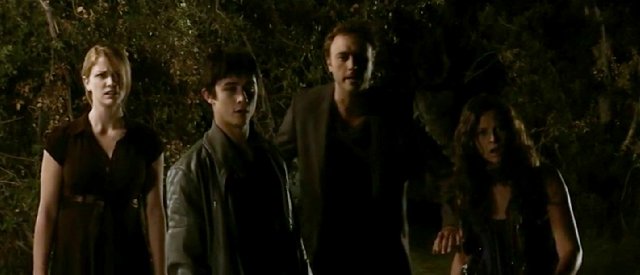
They thought they'd encountered Yogi, but it was just a normal bear.
They thought they’d encountered Yogi, but it was just a normal bear.

Twitter Plot Summary: Two couples break down in a remote forest where they kill a bear. The bear’s mate arrives to unleash carnage.

Five Point Summary:

1. When killing a bear, is a full clip of bullets absolutely necessary?
2. The other bear approaches and is not happy!
3. So are they actually going to get out of there or not?
4. Pointless revelations…
5. The outcome we were all expecting.

There are certain expectations when going in to see a film called Bear. The first of which is, of course, the expectation for at least one person to shout “BEAR!” at a critical moment, whilst pointing in horror to an offscreen beast. That this never happens is perhaps the biggest travesty of all, in a film filled with travesties. As the story gets sillier and the action doesn’t improve, the lack of a good “BEAR!” moment is the real killer.

So how do we end up in this sorry state of affairs? Well, two brothers and their respective female partners head out into the wilds in their trusty people carrier. After their car breaks down, the older, more unhinged brother spots a bear ambling towards them and chooses to unload a full clip of bullets into it. As you do. Understandably, the bear’s mate takes umbrage at this gross injustice and sets out to teach the four very silly humans a lesson, spending the rest of the film stalking them. In perhaps its biggest mistake, the script attempts to put some deep metaphysical meaning to the process of being attacked by a killer bear, but to say it takes a ham-fisted approach would be an understatement. It’s a film called Bear and features a group of people being attacked by one – no deep metaphysical meaning is necessary. Just show us some carnage and some proper bear attack action and we’ll leave happy. Bear struggles to do even that, its poor man’s version of Jaws 4 (itself a poor man’s Jaws) is restricted by a boring location, poorly lit footage and, again, that terrible script.

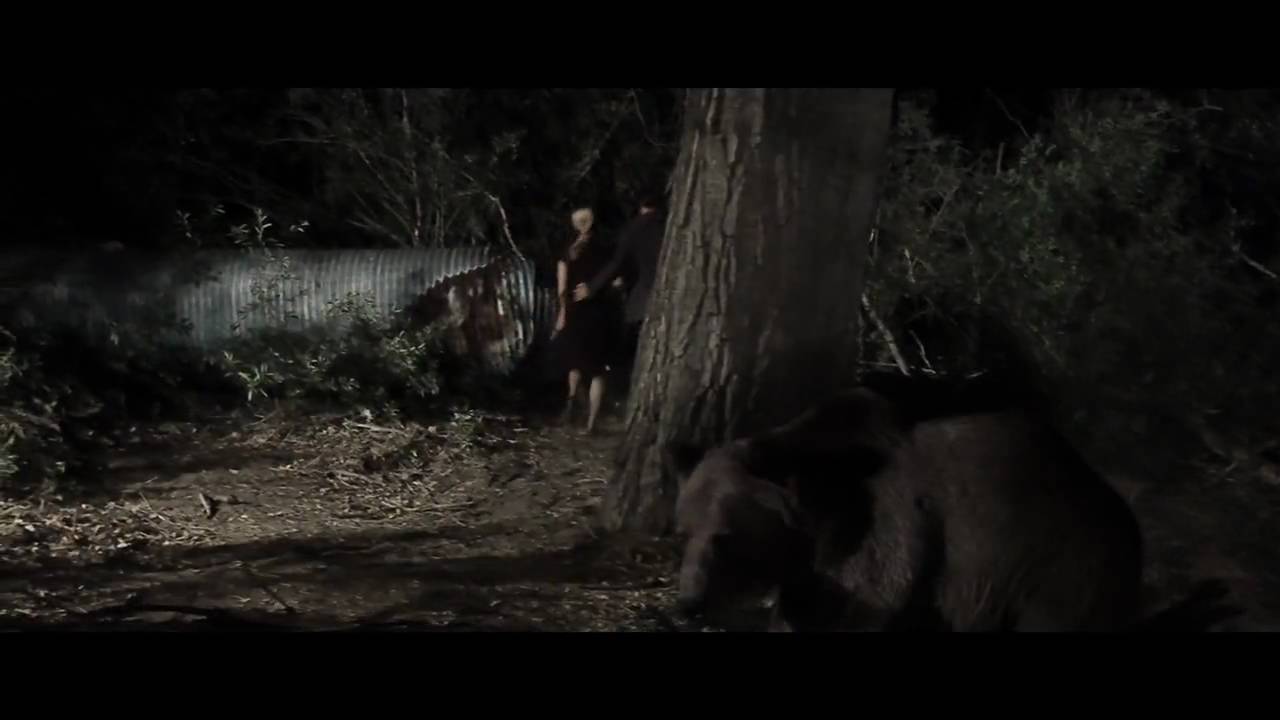
The bear's stalking skills were second to none.
The bear’s stalking skills were second to none.

The characters (I didn’t bother remembering their names – and to be honest it really doesn’t matter) don’t seem to have any idea what they’re doing, jumping in and out of their car with an alarming frequency and no doubt intended by the makers to breathe some life into the story and keep viewers engaged. They could get attacked at any moment! Maybe they could be rescued by passing vehicles! Maybe that hollow log is a good place to hide! Nope. The thing is, this whole concept would work if the characters displayed even the smallest amount of logic. Instead they make arbitrary decisions that have the appearance of progress being made, but instead they’re really just standing still from a narrative perspective.

Given that most of the film features the four of them sat in the car talking and not much in the way of bear action, there is an attempt in the second half to jazz things up by generating a somewhat contentious family revelation that is entirely predictable and unnecessary. Throw in a statement from the younger, seemingly more sensible brother that the bear is judging them for their actions, and in one line of dialogue any possibility for good will towards the film is thrown out of the window. To be honest, there was very little in terms of good will in the first place. Other than the aforementioned faults with location and lighting (don’t even get me started on the performances) the direction also lacks energy. We’re supposed to believe that these four morons are in terrible danger, instead it often feels that the bear is just there to give them a hug. Suffice to say, it’s not very good. Not very good at all.

Score: 1/5

Frances Ha (2013)

0
She'd found the comedy door buzzer. It amused her.
She’d found the comedy door buzzer. It amused her.

Twitter Plot Summary: “Undateable” Frances struggles to find her way in life, her dreams seemingly unachievable.

Five Point Summary:

1. Housemate heaven. It’s clearly not going to last.
2. Frances really does talk a lot.
3. And the best friend’s off to Japan!
4. Some moping.
5. Frances Ha!

Frances is a dancer, although to be fair that doesn’t last very long. She also has a best friend, Sophie, who she doesn’t talk to much because Frances disapproves of her chosen partner. Meanwhile Frances has had to move in with a couple of guys and the running joke between them all is that Frances is undateable. And this you are welcomed to the world of Frances Ha, where not much happens and dreams aren’t achieved – because life has a nasty habit of getting in the way.

The fact almost nothing happens of any consequence, other than Frances constantly moving apartments, is inconsequential itself. Frances deals with the breakdown of her relationship (which seems to happen on a technicality and a misunderstanding, of all things), the subsequent breakdown of the relationship with her best friend, and the fact her career isn’t going exactly to plan all in quick succession. So essentially all of the things that tend to afflict us mere mortals. She’s stuck at that midpoint in her mid-20s, and literally everything seems to start going wrong at about the same time. Via a winning performance from Greta Gerwig, Frances has to find some sense of direction and her place in the world, no matter how small that place might be in the grand scheme of things.

When a woman steals another woman's lip gloss, it gets real.
When a woman steals another woman’s lip gloss, it gets real.

Shot in black and white, director Noah Baumbach is basically presenting us with a quintessential art house film, heavily influenced by French cinema in almost every respect. Yet this is also a tale set in New York and subsequently owes a debt, whether intended or otherwise, to Woody Allen. I get the distinct impression that it was indeed intended, partly because of the setting and partly because of how Frances is characterised – she’s clearly a Woody Allen archetype transposed to a different filmmaker’s production. The particular foibles of the resident New Yorker are put under the microscope in the form of Frances. She agonises over paying for a charge on a cash machine/ATM (in part because of her general money troubles), she laments her career prospects when she has to take work as a waitress to make ends meet, and she laments finding herself metaphorically trapped between the cracks in the pavement. That’s a whole lot of lamenting, right there.

Narratively the latter half of the film struggles as Frances and best friend Sophie go their separate ways, although one could argue that co-writers Gerwig and Baumbach did that deliberately to emphasise the malaise that Frances finds herself in. She mopes around for quite a while after that, even more directionless than she was previously. Ultimately it is a coming of age tale, albeit one that applies to someone in their mid-20s as opposed to the typical teenage stereotype. There are laughs to be had, there is melodrama to be had. Thankfully it all balances out, without ever lapsing into parody or depressing its audience. Ultimately Frances herself may be frantic, frenetic and at times completely barmy – that whole “undateable” thing coming to the fore – but she is also endearing and, if you can stomach her, a fun character to be around.

Score: 4/5