Home Blog Page 59

Captain America: The Winter Soldier (2014)

0
Black Widow was already pondering what hairstyle to use in the next film.

Twitter Plot Summary: Cap is back, dealing with corruption within SHIELD and acclimatising to the modern era’s war on fear.

Five Point Summary:

1. Jumping without a parachute.
2. Old school thriller.
3. That’s a lot of old computers. A lot.
4. The plot thickens.
5. Great big explosions!

There was always a concern going into Captain America’s inevitable sequel that it would fail to live up to the impact of the original film, which went back to World War 2 to introduce us to the paragon of patriotism and give him a bit of a scrap with Hugo Weaving in the process. Keeping Cap’s adventures in the modern era, post-Avengers, may not have been everybody’s cup of tea but it was a necessary step to keep the Marvel Cinematic Universe moving forward – could you really see them stepping back to the 1940s after the Avengers movie?

Anybody who had such concerns can rest easy, as The Winter Soldier hits most of its marks and is thoroughly entertaining from start to finish. Balancing out political thriller with some impressive moments of action, The Winter Soldier makes Captain America a relevant and modern hero. His ideals may originate from 70 years previously, but they remain pertinent to our current age of surveillance and protection through fear. Unsure as to who to trust, Cap goes on the run from SHIELD in a bid to unravel the mystery, aided by a returning Scarlett Johansson as Black Widow and Anthony Mackie who, as you will have seen from all of the trailers, becomes Falcon. Then there’s the mystery of the titular Winter Soldier, although anybody who has seen the first film or even read some of the comics will know exactly who he is. His storyline isn’t developed as much as it could have been, a little more in terms of background and reasons for his existence would’ve done the trick.

Some people just can't hack elevators.
Some people just can’t hack elevators.

Adding to that old-school vibe is the casting of Robert Redford as Alexander Pierce, one of the bigwigs in SHIELD who may or may not be more than meets the eye. The man is fantastic in whatever he does, so it’s little surprise that this carries over to his performance here. It goes to show that comic book movies have moved on some distance since those dark days of David Hasselhoff as Nick Fury, or Dolph Lundgren’s Punisher. The larger universe gets the occasional reference as well – fans of Stephen Strange in particular will be happy for his namecheck.

In terms of Marvel’s choice of directors, I have to say that in this instance the Russo Brothers (Anthony and Joe), known primarily for their comedic work, are an inspired choice. Despite the hefty amount of action they’re adept with camera placement and keeping the action clear. The script too is worthy of mention, with Christopher Markus and Stephen McFeely helping create an old-school 70s thriller vibe for the majority of the running time – and it’s no slouch at a few minutes over 2 hours. Luckily it never drags and remains relatively taught throughout, although the post-credits sequence doesn’t add much of value – without dipping into spoilers, you can take or leave it, it doesn’t add much to the overall narrative. The final act may go against much of the previously established vibe – practical effects and set pieces are replaced by a mess of CGI – but this isn’t enough to entirely ruin the film.

Score: 4/5

A Prophet (2009)

0
He was fashionably late arriving at the Budweiser "Wazzup?!" phenomenon.
He was fashionably late arriving at the Budweiser “Wazzup?!” phenomenon.

Twitter Plot Summary: An Arab teen enters prison and, with no ties to anyone, starts to make a name for himself.

Five Point Summary:

1. Young guy in prison? He’s going to have fun.
2. Shanked. TO DEATH!
3. Allowed outside. For a bit.
4. The balance of power shifts…
5. Is he actually a prophet?

Recently I’ve started to see a few more films in the prison sub-genre, and that has led me to A Prophet (Une Prophete in the original French), a tense and gritty drama following Malik, a 19 year old Arab who finds himself in standard prison after attacking police officers in the outside world. It’s a classic case of bettering yourself whilst behind prison walls, although perhaps not as society may have preferred. Yes, Malik teaches himself to read, but he also ingratiates himself with the Corsicans who make him a runner for them both inside and outside of the prison gates. Thanks to a few strings being pulled Malik gets to spend some time outside prison, ostensibly to complete work for the Corsicans, yet also furthering his own agenda on the side. These trips outside the prison walls also allow him to connect with his friend who happens to be dying of cancer.

Haunted by the ghost of the man he killed, Malik is a man caught between two worlds, trapped between the world of the Corsican inmates and the world of the Muslims – being of Arabic descent means he sits outside both of those main groups. As time goes on, the balance of power within the prison starts to shift, and it’s entertaining watching Malik make the most of this – making deals, playing various groups off against one another. It’s clear that, despite his less than auspicious start, that he’s learned the ropes and is actually somewhat of a tactical genius – in a sense.

"Yeah, looks like he's from good stock. I'll take him."
“Yeah, looks like he’s from good stock. I’ll take him.”

The “prophet” of the title is a loose connection in a sense – Malik dreams about hitting deer in a car, and then that subsequently happens. Is he capable of having visions, or was this just a coincidence? Furthermore, is Malik really being haunted by a ghost, or is it just indicative of his damaged psyche? Questions aplenty, and not especially ones you really need to be concerned with in the grand scheme of things. Overall it could have perhaps been less opaque in this respect, or ditched the prophetic aspect entirely, as it wouldn’t have made a huge amount of difference overall. But then on the other hand, a little ambiguity never hurt, so I don’t really have issue with it.

The power of the story comes through the ever so subtle way in which Malik makes his ascent from being a nobody to becoming the main man within and without the prison walls. At no point does the transition feel impossible or improbable, instead it all occurs naturally and without fanfare. I’m sure in other hands there would have been temptation to either force the story off in an unnatural direction, to make it more violent, more spectacular and even more action-based than what we actually received. It is to the credit of director Jacques Audiard and his co-writers that they didn’t go down the obvious path, and A Prophet has turned out to be a near essential prison-based film as a result.

Score: 4.5/5

Die Hard With A Vengeance (1995)

0
Jigsaw's invitation for them to play a game had somehow crossed franchises.
Jigsaw’s invitation for them to play a game had somehow crossed franchises.

Twitter Plot Summary: John McClane is back, slightly hungover, and has to stop a terrorist from blowing up half of New York City.

Five Point Summary:

1. He’s not going to survive five minutes in that…
2. And lo, Samuel L Jackson has no choice but to stay in the film.
3. Alan Rickman!
4. Everything starts to slot together… endgame?
5. Just when you think it’s over… John McClane doesn’t like to lose.

By the time of this third entry in the Die Hard franchise, times had not been kind to John McClane. After the events of the first two movies evidently proved too much for long suffering wife Holly, we begin here with McClane at his lowest ebb – separated (again) from his wife, suspended from the force and seemingly in the process of drinking himself to death. So that’s exactly the right time for a terrorist to strike, right? And not just any terrorist, one who has a personal vendetta against McClane, for reasons that will become apparent. A deadly game of Simon Says ensues, with McClane run ragged across the city as he tries to complete tasks and avoid the deaths of hundreds of innocent civilians.

As part of his first task McClane is dumped into Harlem wearing what can only be described as a derogatory sign. He’s saved by local shopkeeper Zeus (Jackson) and then the story really gets going as a strained buddy pairing is established. It’s the classic formula of two guys who initially don’t get along and eventually find a mutual level of respect, nothing new there. What is fun however is the interactions between Willis and Jackson, two actors arguably at the top of their game. It’s also a formula that’s been re-used in both additional Die Hard sequels since 1995, with McClane buddied up with an unusual partner for the majority of the film.

Unlike those later entries (reviews forthcoming!) it’s in this third entry that it hits the right notes. Looking past the surface, McClane is a broken man on a path of redemption, attempting to redeem himself in the eyes of… well, everyone else. Meanwhile Zeus is basically called out as a racist, after which he realigns his perspective and he and McClane become equals – as it should be. By throwing these two together they help each other overcome their preconceptions, their flaws and their world concerns – something that was blatantly missing from the fourth and fifth films.

"Now I get to wear the tank top. Ho. Ho. Ho."
“Now I get to wear the tank top. Ho. Ho. Ho.”

It’s easy to argue that this is a stronger film than the second entry, although weaker than the first. The action never lets up for a second, there’s a shot of Alan Rickman plummeting from the top of Nakatomi Plaza (always a winner), and the wild goose chase setup, making McClane solve task after task, is a clever device until McClane decides he’s had enough. Whilst no offence is aimed at Renny Harlin, I discussed in my Die Hard 2 review that he often loses sight of the core story/theme behind the explosions, which is why it’s instantly recognisable that John McTiernan is back in the director’s chair. He balances the two perfectly, switching between the bickering between McClane and Zeus, Simon’s plans to make away with a vast amount of gold and, surprisingly, the efforts of the local police force to stop bombs exploding in a number of schools. It’s testament to both the writer and to McTiernan’s handling of the action that events never get confused.

It also suffers from “Not as good as Hans Gruber” villain syndrome – Jeremy Irons’ Simon is competent and at least has a half decent plan in this instance, but you can’t help but wonder if he’d have made a clean getaway if he hadn’t been blinded by a personal vendetta. When will these villains learn, eh? They should know by now that John McClane doesn’t like to lose.

Put it this way – one New Year’s Eve many moons ago, I had the opportunity of going out to a pub for the evening or stopping at home and watching Die Hard With A Vengeance on DVD. Die Hard won that particular battle, and it wasn’t a particularly fair fight.

Is there an Alan Rickman plummet?: YES! The one from the first film!

Score: 4.5/5

Her (2014)

0

He took staring blissfully out the window to all new levels.

Twitter Plot Summary: A lonely man falls in love with his computer operating system, Samantha. Happens to us all…

Five Point Summary:

1. Such lovely, handwritten… they’re printed? Say what?
2. Hello Samantha.
3. A picnic and a trip to the beach? Bless.
4. She seems a bit distant…
5. And the inevitable happens.

Theodore (Phoenix) is a writer with a particular talent for writing beautiful “hand-written” letters (they’re all computer generated – go figure) for other people, letters that reach to the depths of human emotion and feeling. Yet despite his ability in this field, he remains emotionally closed off in his personal life following his break-up and impending divorce from Catherine (Mara). He does everything you’d expect of a lonely person in a massively connected world – he tries online dating, now with direct voice chat with other lonely types, mopes around a lot and throws himself into his work. Then he discovers a new operating system which will help him take control of his life and meet the right people, etc etc. From here, he falls for the operating system, Samantha (Johansson) and she falls for him, resulting in a blossoming, if not entirely physical, relationship.

What’s impressive is that the relationship between Theodore and Samantha does feel realistic, for the most part you don’t pay too much attention to the fact she’s just a voice coming from a computer. From what is admittedly (Sadly? Thankfully?) not a huge amount of personal experience, the script nails how an “ordinary” relationship would pan out, and Phoenix nails the performance. He’s understated and melancholic, quite the opposite of what we normally expect from him. He’s joined by a similarly downturned performance from Amy Adams as his best friend, although efforts at making her look dour and a bit frumpy fail by a significant margin. Scarlett Johansson meanwhile is, unsurprisingly, perfect as Samantha, although on occasion you do get the feeling that she’s not quite linking directly with the footage, which becomes more obvious when you realise Johansson was a last minute replacement in the recording booth for Samantha Morton, who also read the lines live on set.

“Insert… Part A… into Slot B…”

The script asks a number of questions about the meaning of emotion, the meaning of relationships, the meaning of purportedly finding “the one” in whatever form that may take. In this open minded future world it appears that only Theodore’s ex has any issue with him being in a relationship with an operating system – if anything, the script could have perhaps elaborated on this a little, however I get the impression that this would have been detrimental to the central dynamic between Theodore and Samantha. Everybody else is supportive of the relationship, despite the fact it can never be a physical connection. Whilst efforts are made by Samantha to introduce a surrogate – somebody pretending to be Samantha in physical form – into the relationship, this understandably doesn’t work out.

For anybody concerned that this might become a sub-par Skynet type story, rest assured – this is a romantic drama where one of the partners is a computer. Whilst it might seem a bit odd to say it, it’s nothing more than that. People wouldn’t blink at this exact same story being played out by two people rather than a man and his computer, and that if nothing else should indicate just how well it works.

Score: 4/5

https://www.youtube.com/watch?v=WzV6mXIOVl4

The A-Team (2010)

0
Just a normal day in the A-Team.

Twitter Plot Summary: After being betrayed, the A-Team go on the run whilst they try to clear their name. Same as on the telly.

Five Point Summary:

1. So that’s why BA hates to fly.
2. Betrayed!
3. Flying a tank? Only in the A-Team.
4. Hannibal… doesn’t have a plan?
5. Montage!

A big screen remake of a much loved television series from years gone by is often met with derision and disgust. In the first instance at least, The A-Team TV series was known for its outrageous plot, larger than life personalities and love of a good montage sequence, so the initial signs were good for a big screen adaptation. Then you look at the cast – Liam Neeson as Hannibal Smith, Sharlto Copley as Murdoch, Bradley Cooper as Face, and MMA star Quinton Jackson as BA Baracus – and you know immediately that it should be able to stand on its own two feet and make a name for itself. Maybe even spawn a franchise if the wind is blowing in the right direction.

The final result is a mixed bag. It’s mostly a lighthearted script, willing to throw in a few amusing side notes and wisecracks suiting the tone of the original show, but also not afraid to go big and bombastic with its action sequences. As this is The A-Team, there are set pieces used here that are unlikely to ever be seen elsewhere, being ridiculously big and ridiculously silly in equal measure. Except maybe the Fast and Furious franchise, come to think of it.

It also wouldn’t be The A-Team if they weren’t constantly being chased by the US government, in this case in the form of Jessica Biel. She also has history with Face, just to mix things up a little. Patrick Wilson also crops up as Agent Lynch (fans of the series will realise the significance of his name), who looks like he’s having a blast in every scene. In a whistle-stop and highly improbable opening sequence we’re introduced to the four central characters, get a brief look at the iconic van, establish BA’s fear of flying and his abject hatred of Murdock (crazy fool!), that Face is somewhat of a lady’s man, and that Hannibal loves it when a plan comes together.

The real problem is sewing the seeds of doubt in Hannibal’s ability to command his men. Unlike the series, after a few twists and turns he finds himself unsure what to do next and it’s up to Face to step up to the plate and formulate a plan by planning at least three steps ahead. I don’t object to this per se, but it needed expanding upon. It does at least give Face something to do beyond chatting up women – in this case he learns all about responsibility and the stress of command – maybe not the qualities you want to see in that character, but Cooper pulls off the cocky charm regardless. Murdock is as you’d expect – absolutely crazy, which Copley is more than capable of displaying.

"I don't know who you are, I don't know what you want... but I love it when a plan comes together."
“I don’t know who you are, I don’t know what you want… but I love it when a plan comes together.”

There’s also the undeniable shadow of Mr T as far as BA Baracus is concerned. Before and during casting there was much talk of him reprising his role, but then I think that may have pushed credulity beyond its already shaky foundations. Then there’s the big question – is Quentin Jackson any good as BA? He certainly looks the part, and in all fairness he’s decent. BA has something of an existential crisis where he refuses to kill anyone (a callback to the A-Team’s mantra from the original TV run), which is nicely handled and fits in with what the character goes through. Despite this slightly softer side, he’s still able to kick serious amounts of shizzle dizzle out of the bad guys when called upon, so we actually have a fully rounded personality rather than someone who just hates flying and enjoys calling Murdock a fool.

As a film in its own right, ignoring the influences of the TV series, it’s a big and bombastic affair, inherent silliness mixed with shades of darkness, which on the whole don’t quite gel together. I understand their reasons for making changes to the tone of the series, in particular to appeal to a more modern audience, but I think it would have stood out a little better if it had gone “full A-Team” rather than making efforts to pander to modern action movie sensibilities. Also, remember to stay after the credits for a nice little surprise. In a way I’m disappointed that there haven’t been attempts to make a sequel, but I’ll settle for this and my DVD box sets of the TV series – it seems to be what nature intended.

Score: 3.5/5

http://www.youtube.com/watch?v=ApcuPOWloa8

Fright Night (2011)

0
"The power of Christ compels me, right? I think not."
“The power of Christ compels me, right? I think not.”

Twitter Plot Summary: Charley Brewster’s neighbour is a vampire but nobody believes him except for stage magician Peter Vincent.

Five Point Summary:

1. Fright Night of today = internet and mobile phones. And vampires.
2. We’re heading off in a new direction to the original. I like.
3. Hah, nice cameo.
4. Twists aplenty!
5. Nice call back to “traditional” vampire maidens wearing virginal white robes.

The original Fright Night was a cult B-movie, not exactly top of the list when it comes to possible remakes but it was popular enough to warrant a new version, yet not so popular that everybody will have seen it and thus all cry out in impotent rage at the mere thought of a remake. I’m a card carrying fan of the original, yet I didn’t have any concerns about a new interpretation. I’m not absolutely sure why, but I’ve never had much of a problem with remakes – much like my attitude towards zombie films, if they can do something new to the formula, put their own spin on it, then I’m mote than happy to give it at least one viewing.

This 2011 remake takes a slightly more fun tone from the start, albeit just as knowing and self-referential as the original. The main amendments are the switch from practical effects to CGI, and of course the obligatory amendments to the plot, to both modernise the narrative and introduce a couple of new elements for the fun of it. The CGI doesn’t work as well as it should, but it’s mostly acceptable. By the time Colin Farrell is an entirely CGI creation you may have lost interest, which is a pity.

Colin Farrell makes for a suitable Jerry Dandridge, perhaps more so than Chris Sarandon’s turn in the original to an extent. Much more insidiously sexual than Sarandon, he’s unfortunately left with less to do in terms of the story than Sarandon – he has a couple of big scenes but is mostly intent on being the vampire equivalent of a slasher flick villain. It’s a shame because his introduction is rather good, soon lost amidst the effects and a one note desire to just eat people and not be the least bit subtle about his vampiric qualities.

I was in Dr Who before this, you know. Oh my.

The change to Peter Vincent also seems appropriate for the modern era, a foul-mouthed TV magician based on our current era of David Blaine style magicians rather than the late night horror anthology presenter of the 80s edition. I would argue that there isn’t nearly enough of him in the script, partly because the character is an absolute hoot, and also partly because it’s David Tennant and he is always value for money. I can’t say much about Anton Yelchin, Imogen Poots and Christopher Mintz-Plasse as the teenagers involved in this, as they don’t have much to get their teeth into. Pun intended.

The effects and direction of the story are more impressive than the original, and the amendments to the story keep fans of the 1985 edition on their toes. It’s substantially the same story with different narrative beats. There’s more for Charlie’s girlfriend Amy to do, because of course a lot has changed since 1985 in terms of male/female imbalance in film. Perhaps not nearly enough has changed on the whole, but still it’s progress. Beyond this, however, there’s little more to her than “hot girl stereotype”, no defining characteristics to her beyond that. An opportunity missed. Likewise, Charlie Brewster in this instance is less definably an outsider, just that he fell out with long time friend Ed because of their geeky/nerdy past.

It has to be said then, that despite my good will towards the remake, I still have more affection for the 85 edition simply because it was quite happy to play with the conventions of the vampire film and still create an engaging narrative. Whilst Fright Night 2011 lacks that angle, it is at least a coherent story with some fun dialogue and plot developments.

Score: 3/5

http://www.youtube.com/watch?v=rrdYC-YKkJs

Under The Skin (2014)

0
What a peculiar coat. And pout.

Twitter Plot Summary: An alien, disguised as Scarlett Johansson, drives around Scotland kidnapping young men.

Five Point Summary:

1. Driving around in a van, picking up men.
2. The beach scene. Horrifically disconnected.
3. Perhaps a bit too on the nose with that guy.
4. Aren’t any of these men concerned about the big black empty room?
5. So what’s with those biker dudes?

Do you remember the first time you watched 2001: A Space Odyssey? If you haven’t, go away and watch it before you carry on reading. Done? Now, that feeling there, the one of bafflement mixed with awe and yet more bafflement, is what I felt after seeing Under The Skin, the Jonathan Glazer film set in Scotland and starring Scarlett Johansson as an alien seductress preying on single men or those unlikely to be missed if they were to disappear. Driving around Scotland in her white van, dressed in a ridiculously OTT fur coat and sporting a black bob hair cut, it’s a surreal image to say the least.

Johansson is perhaps a surprising choice for this role, but ultimately she’s perfect because she’s exactly the sort of person you would expect to stand out in such a situation. Yet strangely she blends right in with the locals despite her choice of attire – barely anyone bats an eyelid at her. This is interesting to note because the majority of crowd scenes, so we’re told, were shot with hidden cameras so the reactions of those around her are genuine. There’s a further sense of unease as you’re never quite sure if you’re watching her interact with an actor or a genuine passer-by, which has the potential to take you out of the story. Thankfully the divide between acting and the natural delivery of speech is a thin one, so it doesn’t really affect your enjoyment.

The sound design is fantastic – the music is designed to jar with our usual expectations by featuring prominent screeching strings, and the few moments of absolute silence are broken by sudden blasts of percussion – it’s disconcerting and is yet another element that adds to the sense of alienation and otherworldliness. Visuals too, when we’re not looking at the stunning Scottish countryside, are interesting to say the least. A number of effects sequences are as equally stunning for their simplicity as well as their poetic qualities. I could wax lyrical about these elements for days on end, but for the sake of brevity I won’t.

It’s intriguing to note that the alien only prays upon men, and usually men within a specific age bracket. Despite numerous shots of women going about their business, it’s the men that the alien goes for. It may have something to do with her being in the form of Scarlett Johansson, of course, but it’s one of many questions raised about the alien’s reason for being on Earth in the first place, and is similarly one of many that does not get answered – at least not directly. There are also a number of scenes that are truly indicative of the alien’s lack of knowledge of Earth – the beach scene in particular is one that other reviewers have picked up on and I’m in agreement that it’s a powerful moment, perfectly underplayed and void of human emotion.

Unglamorous, rainy Scotland. Great stuff.

It seems recently that a lot of the best dramatic work comes from films that have almost no dialogue, and Under The Skin is no exception. The story is primarily told through actions, facial expressions and a creative use of imagery. Johansson in particular puts in a stand out performance for the moments where she slowly starts to get a grip on human emotion, as if being in that human skin and interacting with all of these men is starting to wear off on her. By comparison, her similarly alien biker colleagues are disconnected from it – another aspect of the story that is not explained in any great detail, nor is it absolutely necessary. There are various scenes of nudity throughout – feminists will be pleased to note that it’s not all Scarlett Johansson – most of the men she lures back to her grotty house are “on display” as it were. And for everybody else – yes, she does appear in the nip. In terms of nudity I think everybody’s a winner in this case.

Much like after watching 2001 for the first time (and, indeed, the second), I was left with a number of questions after departing the cinema. I get the impression that I’ll be pondering over this one for quite some time. Unlike 2001 (when I get round to reviewing it anyway), I can’t give Under The Skin a perfect score because there are a few moments where the pace decreases and nothing of note really takes place – it starts to circle round and repeat earlier beats. Other than those brief lulls, however, it’s perhaps on par to become one of my top 10 films of the year. For anyone planning on seeing the film after reading this review, I would advise strongly that if you are not a fan of 2001: A Space Odyssey or oblique, low budget science fiction concept films, then you’d be better off giving it a miss. It’s certainly going to be a film to split critics and viewers down the middle in terms of loving/hating it, and I just happen to fall on the “love” side of the fence. Ultimately you have to make your own mind up, but if you enjoy trying to unravel the plot and prefer films that don’t spoon feed you at every turn, then you’ll probably love it too.

Score: 4.5/5

http://www.youtube.com/watch?v=NoSWbyvdhHw

Dead Poets Society (1989)

0
There’s nothing wrong with crouching very low to the ground.

Twitter Plot Summary: A group of schoolboys take influence from their free-thinking English teacher to love poetry and carpe diem, baby.

Five Point Summary:

1. Free thinking teacher in the form of Robin Williams? Oh my.
2. Nice cave.
3. But he wants to be an actor, you old fool!
4. Tragedy.
5. Oh captain my captain!

Robin Williams has been known, on occasion, to turn in a subtle and low key performance, and that is precisely what he did in Dead Poets Society. Playing a former student now returning to teach English in a prestigious all-boy’s school, Williams is suitably low key in his performance and entirely suitable in the role of a subtly anarchic teacher who, despite (perhaps in spite) of his education has come back to instil a little free will and free thinking in his students. In a world where conformity is cherished, where regiment, discipline and adherence to old routines and traditions is praised above everything else, Williams is notable simply for his restrained delivery.

The young cast are equally as impressive, in particular a scarily youthful Robert Sean Leonard and an equally fresh faced Ethan Hawke as two members of the class who, inspired by Williams, reform the titular Dead Poets Society where likeminded individuals (ahh, the irony) get out of the school, head to a cave and write poetry. As you do. This results in the group butting heads with their tutors and their parents as they try and achieve their own goals and, in some instances, make advances on ladies in a nearby school – carpe diem (seize the day) quickly becoming their modus operandi. What is nice to see is that everybody is able to interpret that in their own way, whether it is by seeking an acting career, trying to win the heart of the love of your life (or as close as you can get when you’re in your teens), or simply by trying to be the best you can be.

Oh captain, my captain!

I am not one of those whose opinions are swayed by the fact that the humanities are not entirely portrayed in the most flattering of lights, but I think they’re missing the point. The real issue here is your analysis of texts and those same texts being open to interpretation. The script for Dead Poets Society demonstrates that in some detail, and perhaps exaggerates the teaching methods used by Keating in order to firmly stamp home that point. This extends to the attitudes of most of the remaining teaching staff (some elements of Keating’s methods appear to live on in other classes as we draw closer to the end credits, and also of the parents who have enrolled their sons in this school in the first place. It’s all designed to create an “us vs them” vibe, despite the best intentions of the parents and the teachers on the whole, for the greatest amount of conflict.

As a commentary on the inherent risks of conformity and the perils of slotting into  predefined role, Dead Poets Society succeeds in informing on this subject without smacking you round the chops about it. Whilst some may argue otherwise, if I had children I would fall firmly in the camp of supporting whatever decisions they chose to make and allow them to discover their calling in life without establishing unnecessary barriers. Suffice to say, I’m appreciative of the message at the film’s core, the performances from the entire cast, and the overall presentation. It’s just gentle enough to lull you into a false sense of security but doesn’t lack the ability to surprise and shock you where appropriate. A masterclass in storytelling.

Score: 5/5

https://www.youtube.com/watch?v=wrBk780aOis

The Grand Budapest Hotel (2014)

0
"How's about that then, boys and girls?"
“How’s about that then, boys and girls?”

Twitter Plot Summary: Following the adventures of Gustave H, concierge at the Grand Budapest Hotel and his trusted lobby boy Zero Moustafa.

Five Point Summary:

1. Jude Law!
2. Edward Norton!
3. Jeff Goldblum!
4. Harvey Keitel!
5. Bill Murray!

The cast list for Wes Anderson’s latest should be a clear indication as to the quality of filmmaking on show here. It almost seems as though literally everybody who’s ever worked with Anderson in the past shows up in either a cameo or slightly more substantive appearance, which gives it an additional level of charm and appeal for those who are maybe not aware of Anderson’s previous works. Fan of Jeff Goldblum and his hand acting? Then he plays the executor of Madame D’s will. Bill Murray more your thing? He’s another hotel concierge in a typically brilliant cameo. Harvey Keitel? He shows up without any hair. The list goes on.

Taking all the lessons learned from his previous films, most notably it seems from Fantastic Mr Fox, Anderson has thrown everything into The Grand Budapest Hotel resulting in a zany, madcap and off the wall caper. Amongst the many appeals that this film has are miniatures, surrealism, silly gags, visual humour and a standout comic performance from Ralph Fiennes – who knew that the man who played Voldemort and Amon Goeth had it in him?

Fiennes is Gustave H, the concierge at the Grand Budapest Hotel. Renowned for his love of the older ladies and his cologne of choice, L’Air de Panache. When one of his conquests dies and leaves him a valuable painting in her will, Boy With Apple, it sets off a chain of events that lead to a prison stint and a manhunt from two sides – the one of the law led by Edward Norton, and one led by Adrien Brody and his sinister goon played by Willem Dafoe. All of this takes place in a fictional eastern European country, ostensibly set between the two world wars.

Gustave is joined by Zero Moustafa, a new lobby boy at the Grand Budapest, and it’s the friendship between these two unlikely figures on which the narrative rests. Bearing in mind the significant age gap between the pair, it’s amazing that it works as well as it does. Both are fully realised in terms of their likes, needs and ambitions, and without their strong bond I think the narrative would fall apart quite quickly.

Lovely tache, your Brodyness.

Anderson is no stranger to doing things a little differently to his mainstream brethren, and perhaps one of the more subtle points to note from The Grand Budapest Hotel is the changing aspect ratio of the footage – depending on which era we’re seeing, the aspect ratio is amended accordingly to 1.33, 1.85 and 2.35:1 accordingly.

There are a couple of elements that don’t live up to expectation, in particular the relationship between Zero and Saoirse Ronan’s Agatha, or even the fact the framing device for the central narrative has three levels to it, but these are ultimately minor quibbles in light of the rest of the film. Put simply it’s a delight, balancing gently comedic moments with some occasionally harsh tonal shifts into darkness and melancholy. The fact Anderson manages to balance these so deftly is reason enough alone to book a night at The Grand Budapest Hotel.

Score: 5/5

The Zero Theorem (2014)

0
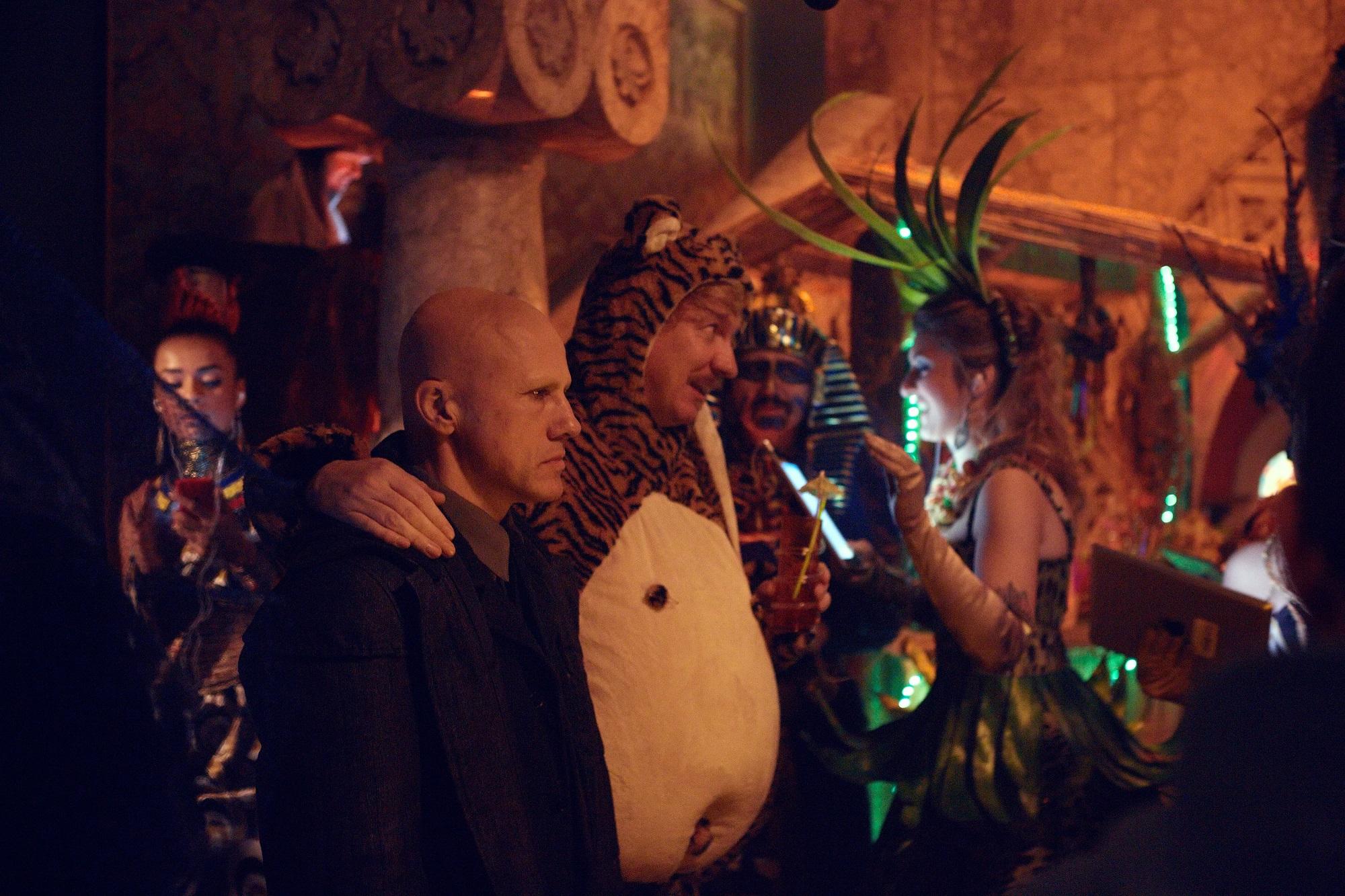
There's a sight you don't see every day...
There’s a sight you don’t see every day…

Twitter Plot Summary: A bald Christoph Waltz tries to solve The Zero Theorem, which posits that all existence is meaningless.

Five Point Summary:

1. Nice to see the lips from Rocky Horror Picture Show found another job.
2. Exactly how I feel at parties.
3. Doctor’s sequence: feels very Twelve Monkeys.
4. Funky VR costume.
5. Er…. what?

Terry Gilliam has always been known for his visual style – he did of course make his start on television by animating for the proto-Python and latterly Monty Python series – and it is none more apparent in The Zero Theorem. It’s Gilliam at his most Gilliam-esque, if such a thing is possible. The story features Qohen, a lowly number cruncher who is certain that, one day, he will receive a phone call that will tell him his purpose. He gets his tenses mixed up, speaking in the royal pronoun (“We think this” etc rather than “I think this”), and is entirely at odds with the world around him – I know exactly how he feels.

The Zero Theorem stands strong against his other work, and has been linked thematically with the likes of Brazil and Twelve Monkeys. They’re appropriate bedfellows for TZT as they share a number of themes, and on occasion they share a couple of similar scenes, but otherwise this is its own beast, a commentary on consumerism, increasing technological reliance and the battle between faith and atheism in whatever form that may take.

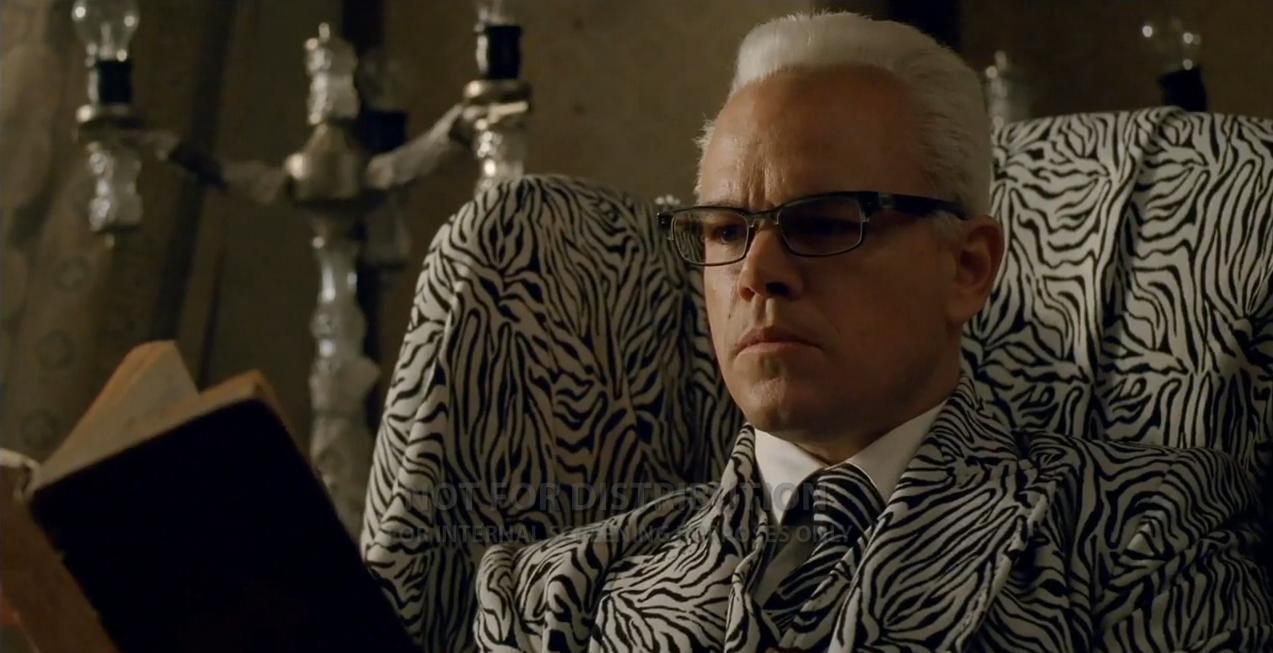
Is it Matt Damon sat on a chair, or a chair that looks like Matt Damon?

Waltz is excellent as Qohen, world weary and always able to turn on the power in ihis performance at a moment’s notice. Melanie Thierry was cast as a seductress, and that’s pretty much all she has to do – there are attempts at giving her some depth, but they don’t quite come through. David Thewlis meanwhile is in full Eric Idle mode, channelling the cheeky persona that Idle is renowned for. Rounding out the core cast is Lucas Hedges as Bob, son of Management and a technical whizz kid sent to help Qohen solve the Theorem. Piece by piece, as Qohen gets closer and closer to solving it, he discovers more and more of his own humanity and, one could argue, his soul and his reason for existence. It’s a nice contradiction, finding something that he’s trying to disprove.

If you look at it close enough then you can tell the budget was infinitely small, as almost the entire film takes place inside the old church that Qohen has purchased and turned into his home. This allows a greater focus on the small cast of characters as Qohen is set the task of solving the titular Zero Theorem, which aims to prove that all life is meaningless. To solve said theorem, Qohen spends days/weeks/months sat in front of a screen essentially playing a video game – an all too real occurrence in this era of video games and modern technology. And that is where TZT is at its strongest, railing against our dependence on modern technology – while it may have everyday uses it’s all very much like the Zero Theorem itself – ultimately pointless. What happens to us when we get lost amongst all of this tech? The outside world is a constant noise, a never-ending stream of information, advertising and products. Retreating into the church, Qohen is surrounded by silence, shut away from the world and able to get on with his own particular kind of existence. Gilliam and writer Pat Rushin don’t force their message down your throat, nor do they make all the conclusions for you. The ending is ambiguous to say the least, and ultimately it’s up to you to decide what the actual resolution is, and what you decide to take away from it.

Score: 4/5